SPME GC-MS analysis of volatile and semi-volatile compounds
SPME GC MS (solid-phase microextraction coupled with gas chromatography and mass spectrometry) is a reference analytical method for the identification and comparison of trace
volatile and semi-volatile compounds Solvent-free and highly sensitive, this technique is widely used for the analysis of aromas , odors , volatile organic compounds (VOCs) , and volatile contaminants in complex matrices from numerous industrial sectors.
What is the SPME GC-MS method?
The SPME GC-MS is based on the combination of two complementary technologies:
Solid-phase microextraction (SPME) is a sample preparation technique that allows for the extraction and concentration of compounds of interest without solvents. It uses a fiber coated with a specific extraction phase, capable of selectively adsorbing or absorbing volatile and semi-volatile molecules present in a sample or its headspace.
Gas chromatography coupled with mass spectrometry (GC-MS) then ensures the separation, detection, and identification of the extracted compounds. After thermal desorption of the fiber, the analytes are separated according to their volatility and affinity for the chromatographic column, and then identified by comparing their mass spectra to reference libraries.
The combination of SPME and GC-MS thus allows for precise qualitative and comparative analysis , adapted to compounds present at very low concentrations, while limiting preparation steps and the risks of contamination.
Depending on the analytical objectives, the method can be complemented by specific detectors, such as the selective sulfur detector (SCD) , in order to more precisely target certain families of compounds responsible for aromatic signatures or characteristic odors.
How SPME GC MS analysis works
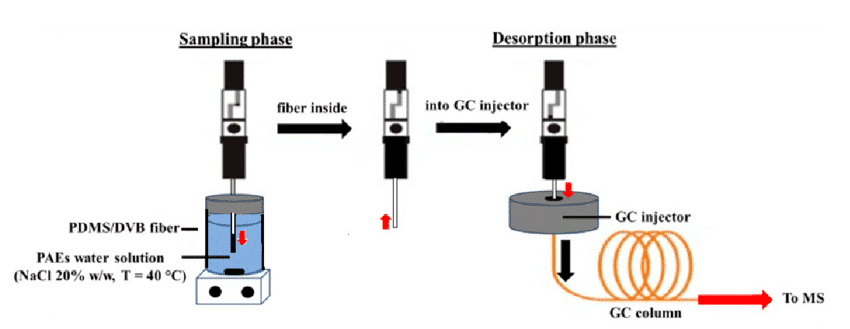
After the extraction step, the SPME fiber is introduced directly into the injector of a gas chromatography (GC) . Analyte desorption is achieved thermally, releasing the compounds trapped on the fiber into the carrier gas stream.
The compounds are then separated on a chromatographic column according to their volatility and their interactions with the stationary phase. Each analyte is eluted at a specific retention time, allowing for efficient separation of complex mixtures.
Mass spectrometry (MS) ensures the identification of compounds by generating a characteristic spectrum for each chromatographic peak. These spectra are compared to reference libraries to provide reliable identification of the detected molecules.
This approach allows:
the qualitative identification of volatile and semi-volatile compounds,
the comparison of profiles between samples,
the analysis of relative variations in concentration between batches or conditions.
Depending on the needs, the analysis can be supplemented by specific detectors, such as the selective sulfur detector (SCD) , in order to target sulfur compounds present in trace amounts and often responsible for marked olfactory signatures.
Technical specifications of the TMA
SPME GC-MS analysis is distinguished by its ability to detect, identify, and compare volatile and semi-volatile compounds at very low concentrations, while minimizing sample preparation steps. Analytical performance depends on the choice of SPME fiber, extraction conditions, and chromatographic parameters.
Analytical principle
sample preparation by solid-phase microextraction (SPME)
direct thermal desorption in the GC injector
gas chromatographic separation
identification by mass spectrometry and comparison to spectral libraries
Types of targeted compounds
volatile organic compounds (VOCs)
semi-volatile compounds
aromas and fragrant compounds
organoleptic markers
volatile contaminants and degradation products
sulfur compounds (optional with SCD detector)
Sensitivity and detection levels
Thanks to the enrichment effect on the SPME fiber, the method achieves very low detection limits , generally on the order of ppb to ppt , depending on the nature of the analytes and the matrix analyzed. This sensitivity makes it a preferred method for the analysis of traces and ultra-traces.
Reproducibility and robustness
SPME GC-MS offers good reproducibility when analytical parameters are controlled:
type and thickness of the fiber coating
extraction time and temperature
extraction method (HS-SPME or DI-SPME)
desorption and chromatographic separation conditions
These parameters are adapted according to the matrix and analytical objectives in order to obtain reliable and comparable results between samples.
Types of results and deliverables
Depending on the client's needs, SPME GC-MS analyses can result in different types of deliverables:
chromatograms and mass spectra
Lists of identified compounds with retention times
comparative volatile profiles between samples
semi-quantitative or comparative results
Advanced statistical analyses available upon request (PCA, heatmaps, batch comparisons)
Examples of molecules analyzable by SPME GC-MS
The SPME GC-MS allows the identification of a wide range of volatile and semi-volatile compounds , depending on the matrix analyzed, the type of fiber used, and the extraction conditions. It is particularly well-suited for studying aromatic profiles, odors, volatile organic compound emissions, and trace contamination.
The examples below illustrate the main families of molecules commonly analyzed by SPME GC-MS. This list is not exhaustive.
Terpenes and sesquiterpenes are frequently found in plant matrices, natural ingredients, flavorings, and beverages. The method allows for the identification of α-pinene, β-pinene, myrcene, limonene, humulene, and β-caryophyllene.
Terpene alcohols , which contribute significantly to floral, fruity, or resinous notes, are also well-suited to analysis by SPME GC-MS. Commonly detected molecules include linalool, geraniol, nerol, and α-terpineol.
aldehydes and ketones are important markers of matrix freshness, oxidation, or degradation. SPME GC-MS, for example, allows the analysis of hexanal, (E)-2-hexenal, nonanal, or octanal, which are used in quality control and batch comparison.
Esters , in particular, the identification of hexenyl acetate, isoamyl acetate, geranyl acetate, and ethyl hexanoate.
Sulfur compounds , detectable in trace amounts, can be analyzed by SPME GC-MS, possibly supplemented by specific detection methods. Molecules such as dimethyl disulfide, dimethyl trisulfide, methanethiol, or certain volatile thioesters are often involved in distinctive olfactory signatures or off-flavors.
Finally, SPME GC-MS is commonly used for the analysis of volatile organic compounds (VOCs) in environmental, industrial, or materials contexts. It notably allows the detection of molecules such as toluene, ethylbenzene, xylenes, and styrene.
Key takeaway: SPME GC-MS allows the identification of several hundred volatile and semi-volatile compounds , depending on the matrix analyzed and the protocol implemented. Identification relies on the use of extensive spectral libraries and the laboratory's analytical expertise.
For which matrices?
SPME GC-MS is a method of choice for manufacturers seeking detailed characterization of volatile compounds and reliable comparison between samples.
Main industrial applications
The SPME GC-MS is used in many industrial sectors whenever the analysis of volatile and semi-volatile compounds is a matter of quality, performance, safety or regulatory compliance.

Léa Géréec
Technical and scientific expert